Mantras
Calming mantras & affirmations: do they actually work?
"Just tell yourself you're fine" can feel hollow, and sometimes it backfires. Here's what the research actually says about mantras and affirmations, and how to write ones that land.
The short answer
Calming mantras and affirmations can work, but only when they're believable. Research shows lofty statements you don't buy ("I am fearless") can backfire, while grounded, values-based ones ("this is hard, and I can handle hard things") genuinely steady you. Keep them kind, present-tense, and true to you.
Mantra, affirmation, litany: what's the difference?
They overlap, but roughly: a mantra is a short phrase you repeat to steady and focus the mind. An affirmation is a statement about yourself or your values. A litany is a set of lines you move through in order, a small script you can lean on in a hard moment. All three are structured, intentional self-talk.
Do they work? Yes, with a real catch
There's genuine science behind self-affirmation. When it's focused on your values, what matters to you, it can measurably lower stress and defensiveness (this is well-studied work from researchers like Claude Steele and, later, Cohen and Sherman).
But here's the catch that most "just think positive" advice skips: a 2009 study by Wood, Perunovic, and Lee found that lofty positive statements can backfire. When people with low self-esteem repeated things like "I am a lovable person" that they didn't actually believe, they often felt worse, not better. Your mind flags the gap between the words and the truth and pushes back.
So the goal isn't grand, it's believable. This is how cognitive behavioral therapy (CBT) approaches self-talk, too: realistic and balanced beats blindly positive.
How to write a mantra that lands
- Believable over grand. "This is hard, and I can handle hard things" beats "I am fearless."
- Kind and present-tense. Talk to yourself the way you'd talk to someone you love.
- Values, not just moods. "I can do the next right thing" points somewhere, even when you feel awful.
- Yours. The phrase you write for yourself will almost always beat one you were handed.
Build a litany for the hard moment
String a few lines together in an order that walks you down: name it, steady it, point to a next step. For example, "This is a wave. I've ridden waves before. I just need the next breath." Save it somewhere you can reach it fast, before you need it.
A few calming mantras to borrow
- "This feeling is uncomfortable, but it isn't dangerous, and it will pass."
- "I've made it through hard moments before. I can make it through this one."
- "I don't have to figure everything out right now."
- "I can do the next right thing."
Pair one with a physiological sigh or a moment of grounding to give it more staying power.
Mantras for specific situations
- For anger: "I can be angry and still choose how I act." "This feeling is information, not an instruction."
- For grief: "I don't have to be okay right now." "Missing them is the shape love takes now."
- For self-doubt: "I don't have to feel ready to start." "One honest step counts more than a perfect plan."
- For panic: "This is my body, not my judgment, sounding an alarm." "It will crest, and then it will pass."
Saying it out loud vs. in your head
Out loud tends to work better when you can manage it, it recruits your voice and hearing alongside the thought, which makes the phrase harder to skim past the way a silent repetition can become. If out loud isn't possible, mouthing the words or writing them down captures some of the same effect. Timing matters more than people expect, too: said once, calmly, before a spike tends to do less than the same line repeated slowly three or four times once you're actually in it, when your mind has something to hold onto instead of spin on.
Tools for this in the app
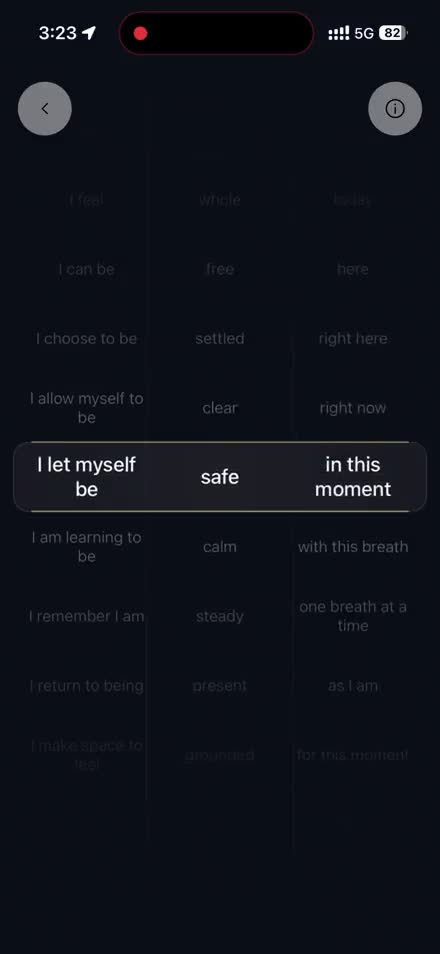
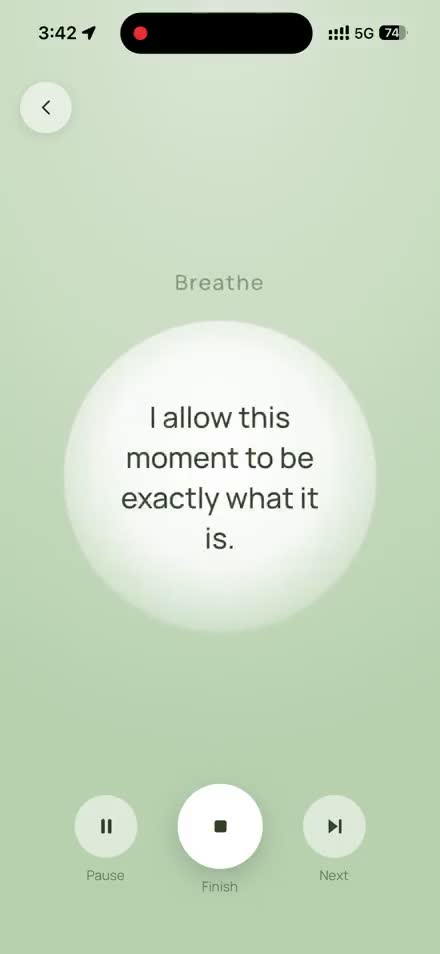
Your words, ready when you need them.
Write mantras and litanies, save them in collections you name, and hear them back, steady phrases to hold onto.


Common questions
Do affirmations actually work?
Sometimes, with a catch. Values-based self-affirmation has solid research behind it for reducing stress. But lofty statements you don't believe (like "I am completely confident") can backfire and make people with low self-esteem feel worse. Believable, values-based phrasing is what works.
What makes a good calming mantra?
Believable, kind, present-tense, and rooted in your values rather than a forced mood. "This is hard, and I can handle hard things" works better than "I am fearless," because your mind doesn't reject it as a lie.
What's the difference between a mantra and an affirmation?
A mantra is a short phrase you repeat to steady the mind. An affirmation is a statement about yourself or your values. A litany is a set of lines you move through in order, like a small script for a hard moment. All are forms of structured self-talk.
Should I say a mantra out loud or in my head?
Out loud tends to work better when you can manage it, it recruits your voice and hearing alongside the thought, making the phrase harder to skim past. If that's not possible, mouthing the words or writing them down captures some of the same effect. Repeating it slowly a few times once you're actually in the moment works better than saying it once, calmly, in advance.
Not medical advice. Mantras are a self-help tool, not treatment. If anxiety or low self-worth is weighing on you, a therapist can help. In crisis, contact your local emergency number or a crisis line.
Sources
- Steele, C. M. (1988). The psychology of self-affirmation. Advances in Experimental Social Psychology.
- Cohen, G. L. & Sherman, D. K. (2014). The psychology of change: self-affirmation. Annual Review of Psychology.
- Wood, J. V., Perunovic, W. Q. E. & Lee, J. W. (2009). Positive self-statements: power for some, peril for others. Psychological Science.